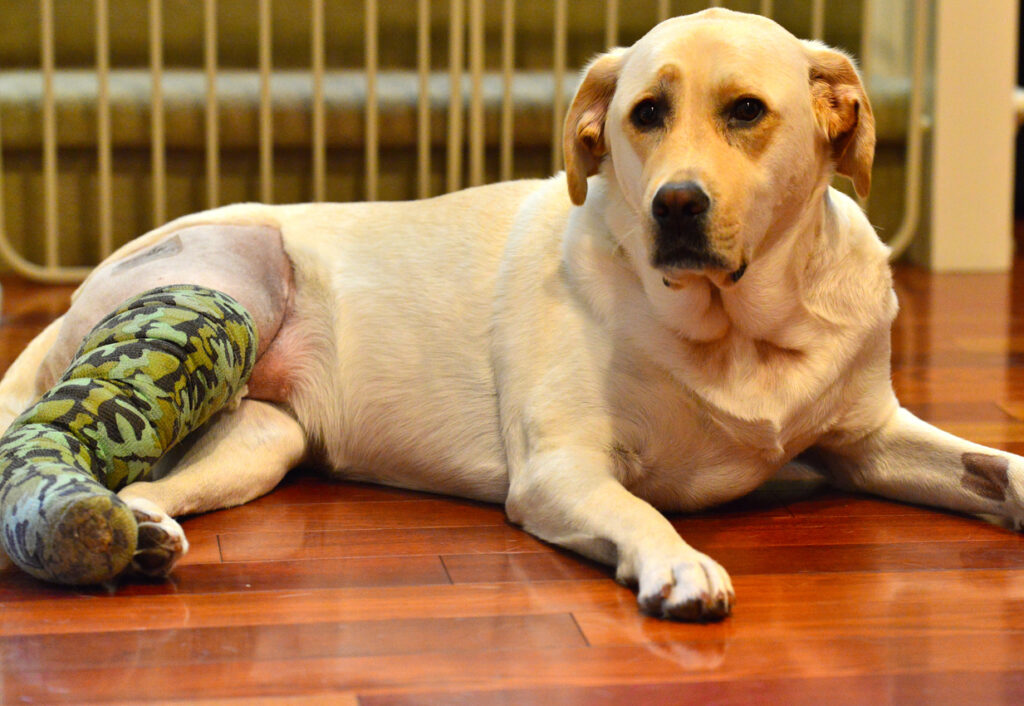
Once your veterinarian has diagnosed your dog with CCL tears (cranial cruciate ligament disease), they will usually recommend TPLO surgery. For many years, it has been considered the gold standard for dog knee surgeries, particularly for medium to large, active or working breed dogs. But, due to rapidly advancing veterinary technologies and techniques for both orthopedic surgery and postoperative rehabilitation, there are many pet parents now asking the question:
Does TPLO remain the gold standard for treating CCL tears in dogs, or are there now equally effective alternative treatments available?
Today, Cranial cruciate ligament (CCL) tears and the disease are diagnosed and treated by veterinary orthopedic surgeons using updated treatment approaches based on in-depth studies and research on dog CCL tears and surgery, better techniques of surgical repair, complete postoperative follow-up rehabilitation programs, etc.
If left untreated, cranial cruciate ligament disease will invariably progress into debilitating osteoarthritis and chronic pain.
What Is TPLO Surgery? A Simple Explanation for Dog Owners
TPLO Surgery (an abbreviation of Tibial Plateau Leveling Osteotomy) is a special type of canine orthopedic surgery with connective tissue (e.g., ligament) problems that helps stabilize the knee and therefore does not necessarily repair the Ligament itself.
Here is how TPLO Surgery works:
- The shin (or tibia) is cut and rotated
- Then the slope is “flattened” or changed;
- A specialized bone plate is attached to the bone to stabilize the leg
Thus, it prevents the leg from moving from front to back while healing.
Once complete, the dog’s femur can no longer slide forward, restoring stability to the knee without the CCL.
“TPLO Surgery stabilizes a dog’s knee by focusing on biomechanical properties rather than replacing a faulty ligament.”
Because of this biomechanical focus, TPLO is now considered the ideal dog knee surgery in the repair of the canine cranial cruciate ligament.
Why TPLO Surgery Is Still Considered the “GOLD STANDARD” for CCL Tears in Dogs
Many clinicians still use TPLO surgery as a “gold standard,” despite the emergence of new surgical procedures, because of its long-term results.
1. Long-Term Results of TPLO Surgery
TPLO surgery has been studied extensively over the years, with such evidence showing increased function of the limbs through many situations of overloading, recovery time, and the highest degree of comfort of patients, as indicated in clinical trials. This is particularly true in medium to large-sized dogs and/or athletic breeds.
2. TPLO Is More Stable Than Any Other CCL Surgery
Unlike the lateral suture techniques, TPLO does not rely on scar tissue or artificial ligaments, which results in:
- Reduced postoperative knee instability
- A decrease in the risk of a late surgical failure
- More consistent outcomes in active dogs.
3. TPLO Surgery Is the Most Appropriate for Athletic and Active Dogs
TPLO is still the best surgical option for:
- Sporting Dogs
- Working Dogs
- Active Family Pets
Dogs that are anticipated to return to a high-energy lifestyle or engage in agility events, for example.
Many times, when therapeutic exercise is incorporated into a dog’s recovery from TPLO, the dog will be able to achieve almost normal mobility.
TPLO vs. TTA: What the Latest Veterinary Studies Show
When looking at the recent research comparing TPLO vs. TTA surgery,
The statistics that were determined are as follows:
- An average of 15 – 16% of dogs that undergo TPLO surgery develop complications
- An average of 20 – 21% of dogs that had a TTA developed complications.
- TPLO has a slightly lower incidence of major complications compared to TTA.
In fact, the majority of the TPLO complications that are encountered are minor and can be managed successfully, such as swelling or temporary stiffness.
TPLO is Not an Option for All Dogs
The concept that we treat each dog as an individual has gained much attention in the veterinary field. Thus, we create individualized treatment plans even for dogs with CCL injuries. There are instances when TPLO may not be the most suitable option.
TPLO may not be ideal for:
- Small dogs weighing less than 15 pounds (6.8 kg).
- Dogs over 7 years old that are not very active any longer.
- Dogs that may have financial or medical limitations.
- Dogs whose tibial anatomy does not fit TPLO but would be better suited for other types of surgical procedures.
Alternative treatment options include:
- TTA-Tibial Tuberosity Advancement
- Lateral Suture Stabilization
- Conservative Treatment in Select Instances
There is no “Best” dog knee surgery. It varies based on each patient’s needs
Innovations in TPLO Surgery and Canine Orthopedic Care
Recent technological developments have significantly improved the desired outcomes of obtaining a TPLO:
- Sophisticated Surgical Planning Software
- Highly Engineered Implant Designs
- Decreased Rate of Infection/Irritation
- Furthermore, Better Management of Post-Surgical Pain
- A New Emphasis on Early Physical Therapy
Recent research has also demonstrated that the quality of rehabilitation is just as important as the surgery itself.
Importance of Post-Operative Rehabilitation After TPLO
The success of the recovery process from TPLO surgery in dogs is highly dependent upon the use of an effective rehabilitation program.
A Typical Rehab Program Often Consists Of:
- Controlled Walking on a Leash
- Hydrotherapy or Underwater Treadmill Sessions
- Strengthening & Range-of-Motion Exercises
- Weight Management and Nutritional Support
Dogs That Complete Formal Rehab Programs Typically Experience:
- Faster Functional Recoveries
- Increased Muscle Mass
- Slower Progression of Arthritis
Is TPLO Still Considered The “Gold Standard” For Treating CCL Tears in Dogs?
Yes, TPLO is still one of the most effective and biomechanically stable surgical techniques for repairing cranial cruciate ligament (CCL) injuries in dogs, especially in medium to large breeds that are either active or athletic, and for ensuring stability of the joint long-term.
Conclusion
TPLO surgery is typically considered the standard treatment for cranial cruciate ligament (CCL) injuries, but it has now been modified depending on additional variables to derive a customized protocol to treat the individual dog based on their habit patterns, anatomy, and the use of their legs.
FAQs
Is TPLO surgery better than TTA for CCL tears in dogs?
TPLO usually gives the best stability on larger and/or very active dogs, while TTA may also give similar results in certain selected instances.
How long does recovery take after the TPLO surgery?
The most common recovery time to be able to walk without discomfort is 4-6 weeks. But the total process of healing before returning to their full activity takes 4-6 months, if properly rehabilitated.
Will my dog experience pain during or after TPLO surgery?
The pain caused by any surgery has been extremely well controlled using anesthetic agents and medications. Most of the dogs after the TPLO surgery will be able to bear weight within a few days of having surgery.
Will my dog, with a torn CCL, heal without surgery?
Most likely, no. In a mild-mannered or low activity dog, conservative treatment may be effective, but the instability will ultimately become worse over time.
How do I choose the right TPLO surgeon?
Ask the following questions:
How many TPLO surgeries have you performed?
What is your complication and revision rate?
What is your post-operative rehabilitation plan?
Are you board-certified or formally trained in orthopedic surgery?