
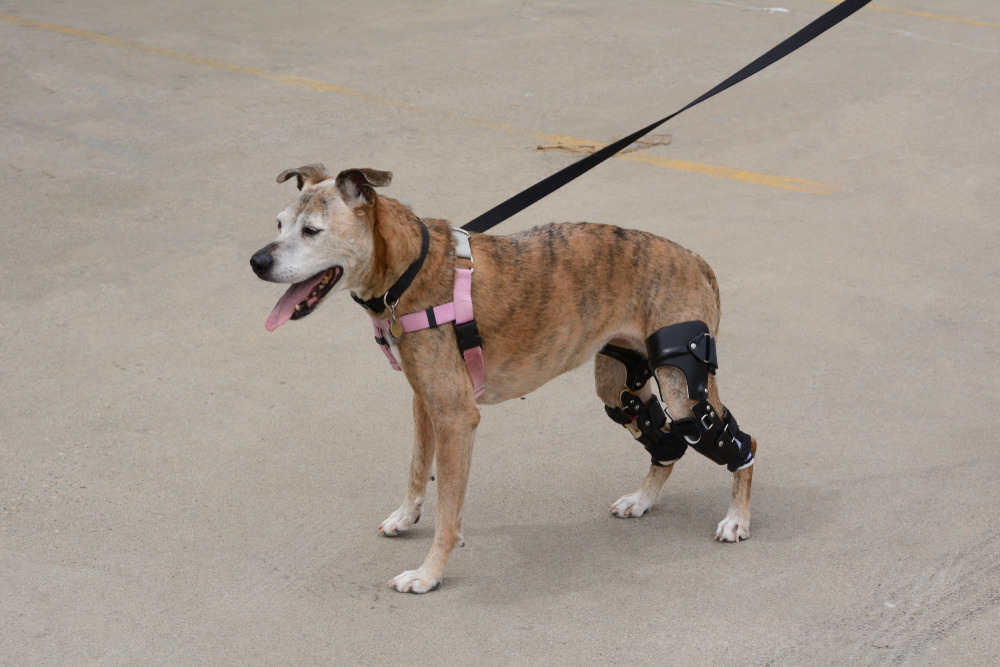
Understanding the Risk Factors of ACL Tears – Ever you have seen your dog just limp, or hesitate to jump onto the couch, or have difficulty getting up after lying down, your heart likely sank. One possible culprit? A tear in ACL – or rather in dogs, a tear in CCL (Cranial Cruciate Ligament). It is an orthopedic injury that is the most widespread in dogs and may affect any type of breed at any age. It brings good news to you that you can do something practical by being aware of the risk factors of ACL tears in dogs, to prevent them or at least identify them at the earliest stage. Let us take a step through the risk factors of ACL tears.
What Is An ACL (CCL) Tear?
Imagine that the cranial cruciate ligament (CCL) is a knee stabilizer of your dog. It is a small and yet powerful band of tissue that causes the knee joint to remain in place when your dog runs, jumps, or even when walking around. Once this ligament is weak or snaps, it makes the knee unstable. Your dog may limp, or put weight on one leg, or not put any weight on it at all. In the long run, it may cause painful arthritis and irreversible joint damage.
In human beings, tears of the ACL usually arise in the event of an unexpected sports injury, twisting, or mislanding. In dogs, however, it is a different story. The majority of tears in dog ACL are degenerative, i.e., the ligament becomes worn over time, and then it takes one small movement that causes it to be torn over the edge.
1. Breed and Size: That is Just the Way Some Dogs are Built
Unfortunately, not every dog is built with similar joint strength. Bigger breeds, such as Labrador, Rottweiler, Newfoundland, and Saint Bernard, are much more likely to have ACL injury, again, due to their size. Big dogs are heavier, and the additional weight exerts permanent strain on the knee ligaments. Over the years, it adds up.
Genetics and shape may be major factors even among small breeds. Dogs suffering a steep slope of the tibia impose additional strain on their ligaments during every movement, and thus, are more susceptible.
What you can do: Since your dog belongs to one of these breeds that are at a higher risk, it is worth being extra careful with their weight, exercise, and diet. Prevent, do not react.
2. Weight: The Secret Menace of Healthy Knee
This is the fact – an extra pound means extra pressure. Even being not much overweight, it can impose much pressure on the knees and joints of your dog. As an example, when your dog is 10 pounds overweight, it is like a person having an extra 50 pounds that he/she carries with him/her throughout the day. This force of additional force eventually wears down the ligament and renders it very easy to tear.
Obesity also impacts muscle strength and balance, implying the provision of less support to already working joints.
Try this:
- You are expected to feel the ribs of your dog, but not to see them.
- Substitute certain snacks with recreation or love.
- Make food portions small and regular, and select the food based on the life stage of your dog and breed.
- Minor changes in nutrition and activity can help with the health of joints.
3. Age, Gender, And Neutering
ACL tears may occur at nearly any age, although they typically occur in the middle-aged dog, which is between 4-8 years of age. Interestingly, studies indicate that the spayed females appear to be a little bit at a greater risk of CCL injuries. This is not fully understood, but it possibly is because of the hormonal changes that influence the liking strength.
Early spaying and neutering is also debated, with some saying that this can lead to more orthopedic problems since hormones are useful in balancing out the bones and muscles’ growth. This is not to say that you should not spay or neuter your dog, but that will be the case. It only means that the time and personal situation count. By simply having a fast chat with your vet, you can determine the most appropriate plan to get your pup.
4. Anatomy and Body Structure
Every dog’s build is unique. There are those whose legs and joints are perfectly matched, and those whose quads are small and make their knees a little more exposed. As an example, a sharp tibial plateau generates greater sliding pressure within the joint with each step that your dog makes. With time, that stress becomes repetitive and deteriorates the ligament.
Certain breeds, particularly those bred to look a certain way, can also be conformed in such a manner that they create more stress on the knees naturally. You can never change the anatomy of your dog, so a knowledge of these dangers will enable you to be more active in control, by weight control, training, and very careful selection of activities.
5. Level of Activity and Conditioning
This one may come as a shock: routine and exercise in balance actually prevent ACL tears. Fit and healthy dogs are more joint-stable and musculoskeletal supported. The trouble lies in the fact that a dog, which is generally sly, grows crazy in play, dashes, turns about, or leaps after days of rest. The acute movement of such a type may overwhelm a weak ligament.
Dogs that are exercised regularly – walking, light strength training, swimming, or balance exercises- are less likely to incur injuries. It is consistency and not intensity that matters. Always keep your dog in motion, but in a safe manner.
6. Degeneration Over Time
In contrast with humans, a majority of ACL ruptures in dogs do not occur as a result of a single dramatic event. Rather, it is a gradual degradation. It is months or years, and the ligament fibers become stretched and frayed, and weak until a single jump or turn can completely tear them.
That is why you may hear an owner telling you, He was only walking, and he suddenly began to limp. The damage had long been waiting in the silence.
7. Past Injuries And Genetics
The dogs that have ruptured one ACL have a high probability of rupturing the other one in a short period of time, in some cases, less than a year later. Why? Since they are likely to lean their weight on the good leg, which questions its workload.
And similarly with human beings, genetics can also be significant. Certain family lines are more inclined to ligament weakness or misalignment of the joints. It is prudent to prevent this at the earliest possible stage in case your dog has a family history of knee issues.
Conclusion
AAn ACL tear can be a heartbreaking experience for both you and your dog – but it is not inevitable. With the right care, awareness, and a bit of prevention, you can keep your pup running, playing, and living their best life for years to come. At Pet Care Partners, we guide pet owners on preventive strategies and early signs to watch for, helping dogs stay active and healthy.
FAQs
How can I tell if my dog has an ACL tear?
Look for limping on one leg, stiffness after resting, or your dog “toe-touching” when standing. If you see these signs, schedule a vet checkup as soon as possible – early intervention is everything.
Can small dogs tear their ACLs, too?
Yes. While big dogs are at higher risk, small dogs are not immune. Being overweight, under-conditioned, or having poor leg structure can make even little dogs vulnerable.
Will my dog need surgery if they tear their ACL?
Many complete tears do need surgery, but partial tears can sometimes be managed with rest, rehab, bracing, and lifestyle changes. Your vet will help decide what is best for your dog’s particular case.
Can I prevent a second ACL tear after surgery?
Yes. Keep your dog lean, stick to a rehab plan, and continue gentle strengthening exercises even after recovery. Protecting the other knee starts right away.