
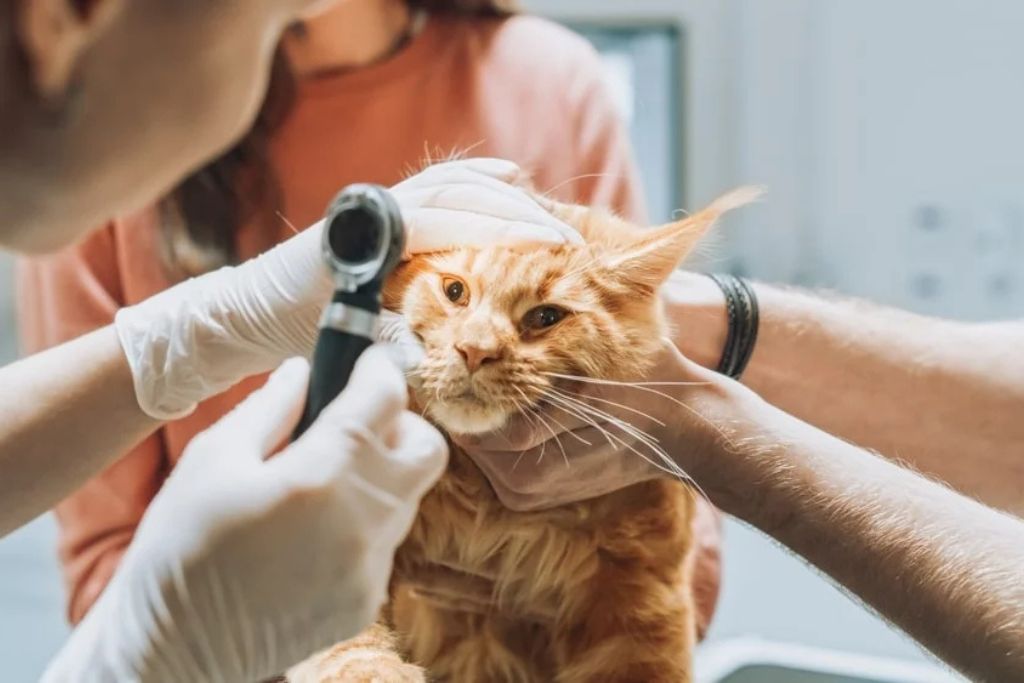
Can My Cat Get LASIK Eye Surgery? – If you wear glasses or contacts, you have possibly heard about LASIK surgery and how it can give people clearer vision. It is life-changing for many people, so it is only natural to wonder: “Can my cat get LASIK eye surgery?”
The short answer is no, cats can’t have LASIK. But that doesn’t mean you are out of options if your kitty is having eye problems. Let’s break this down in simple terms – why LASIK is not for cats, what eye issues cats face, and how you can help keep your feline friend’s vision as healthy as possible.
What Exactly Is LASIK?
LASIK stands for Laser-Assisted in Situ Keratomileusis – a mouthful, I know. It is a procedure for humans where a special laser reshapes the cornea so that light hits the retina correctly. The result? Clearer vision without glasses or contact lenses. It is mostly used to fix things like:
- Nearsightedness (difficulty seeing things far away)
- Farsightedness (difficulty seeing things up close)
- Astigmatism (difficulty seeing things at any distance)
In people, these problems – and the procedure to fix them – are treated safely, effectively, and are quite common. In cats, however, it is a little different.
Why Cats Can’t Get LASIK
The bottom line is this: LASIK is a human fix to a human problem, and there are a few reasons why cats don’t fit the model.
Consider: Cats don’t have eyes like humans. Cats have vertically oriented pupils, a reflective layer (the tapetum lucidum) that helps them see in the dark, and a different structure to their cornea. The lasers used for LASIK surgery are intended for human eyes, not for cat eyes.
Secondly, they don’t have the same problems as humans. Cats rarely become nearsighted or farsighted in the way people do. Cats’ eyes are naturally built for hunting, detecting movement, and seeing at night, not for reading fine print.
Thirdly, the cat would have to undergo surgery. This is risky because an important aspect of LASIK is the patient having to be still and understand care instructions post-operatively (e.g., “do not rub your eyes”). Good luck telling that to a cat.
Finally, and most importantly, they do not require corrective vision (i.e, 20/20 vision is not necessary for a cat). Granted, if cats could get LASIK, they wouldn’t experience any improvement in their quality of life. Cats rely on their other senses – smell, hearing, and whisker sensitivity – much more than they do the sense of sight when navigating the world.
Common Problems That Cats Can Have with Their Eyes
The fact that cats don’t require LASIK doesn’t mean their eyes can’t have problems. Some common problems that you may see cats experience include:
Cataracts – A clouding of the lens, creating blurry vision.
Glaucoma – Pressure in the eyeball that may be painful and can lead to blindness.
Conjunctivitis (pink eye) – Red and irritated eyes caused by infection, allergies, and/or irritants.
Corneal ulcers – Painful, injurious scratches or sores on the surface of the eye.
Progressive retinal atrophy (PRA) – A genetic disorder that results in gradual fading or loss of vision.
It is time to consult with your vet if you observe your cat bumping into furniture, squinting, pawing at their eyes, or if their eyes look cloudy or red.
What Can Be Done for Cats with Eye Problems?
While there is no LASIK for cats, there are still treatments that can be offered by the vet, depending on the condition:
Medication – Eye drops, lotions, ointments, or oral medications to treat infections and inflammation
Surgery – Some common surgeries include cataract removal or correcting eyelids that roll inward. These surgeries are different from LASIK but may still save or improve your cat’s vision.
Comfort Care – For irreversible blindness, making your home more blind-cat-friendly helps, such as keeping furniture in the same place, using scent cues, and avoiding cluttered spaces.
Do Cats Really Need Perfect Vision?
Here is some good news: cats don’t need crystal-clear vision to be happy. They are experts at using their other senses to get around. Their night vision is much stronger than ours; they can detect even the slightest movement, and their whiskers act like built-in sensors. Even blind cats often adapt beautifully and live long, joyful lives.
So, if your cat is diagnosed with vision issues, don’t panic. With a little extra care and guidance from your vet, your kitty can still thrive.
Conclusion
So, let’s circle back: Can my cat get LASIK eye surgery? No, they can’t, and more importantly, they don’t need it. Cats simply don’t struggle with the same kinds of vision issues that LASIK was designed to fix. If your cat seems to be having trouble seeing, the best thing you can do is take them to your veterinarian or even a veterinary eye specialist. They can identify the cause and provide treatment options that are safe and effective for cats.
Your cat doesn’t need LASIK to live a great life – they just need you, your love, and good veterinary care.
FAQs Related To Cat LASIK Eye Surgery
Can cats wear glasses or contact lenses instead of LASIK?
No. Cats wouldn’t tolerate glasses or contacts, and they don’t need them since their vision doesn’t require correction in the same way as human vision does.
What should I do if my cat seems to have vision problems?
Book a vet appointment. Your veterinarian may refer you to a veterinary ophthalmologist who specializes in animal eye care.
Are there surgeries available for cats with eye conditions?
Yes. Cats can have cataract surgery, corneal repairs, or eyelid corrections if needed. These are very different from LASIK but can help maintain eye health.
Can blind cats still have a good quality of life?
Yes. Various blind cats adapt so well that you would hardly know they can’t see. They use their other senses, and with a safe, consistent environment, they can be just as playful and loving as sighted cats.