
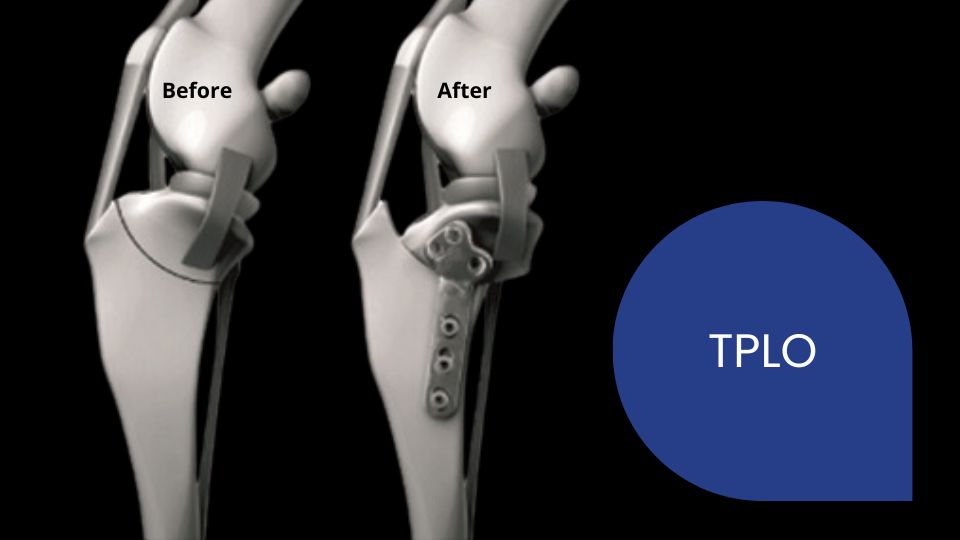
If your dog has an injury to his or her cranial cruciate ligament (CCL), you likely feel nervous, uncertain, and confused about what to do next. All dog owners who have been told their dog needs to have a TPLO procedure experience a similar set of emotions. When many pet owners hear about a TPLO for their dog, the first thing they do is Google it. The most common question that pet owners will likely ask themselves is:
What is the percentage chance that TPLO surgery will help my dog?
What Is The Success Rate of TPLO surgery?
One of the most common responses to that question is that the success rate for TPLO surgery on dogs is estimated to be between 90% and 95%. That’s right — 90%-95%!
This means that 9 out of 10 dogs that have undergone TPLO surgery return to normal daily activities. Many of them will resume hiking and running as if nothing had ever happened to them.
TPLO is considered the gold standard by many veterinary practitioners when it comes to the treatment of CCL injuries in dogs because TPLO surgery provides the dog with the best opportunity for long-term freedom from pain and functional mobility.
You are probably asking yourself, “Is TPLO a worthwhile procedure?” — You can achieve peace of mind from this success rate.
Why Has TPLO Surgery Been So Successful?
Let’s keep things simple, without delving into a lot of technical details. When your dog ruptures its CCL, the joint becomes unstable, and every step is painful because of the shifting of these bones. By changing the angle of the tibia (the shin bone), TPLO surgery helps to stabilize the knee to its original (natural) position, regardless of the activity level of the dog. This explains why many dogs can begin to place weight on their leg within 24-48 hours following surgery. Impressive indeed! Here are some of the many reasons why TPLO has such a high rate of success:
- It will stabilize the knee in a natural manner
- It usually reduces the likelihood of long-term arthritis
- Dogs tend to recover from TPLO surgery more quickly than from other types of procedures
- It has been successful with both small and large dogs, working on any level of activity: active or inactive dogs.
- After recovery, the solution is permanent and durable.
To summarize: the dogs who underwent TPLO feel better, move better, and are healthier.
What Does “Success” Actually Look Like?
Numbers are great, but what does it really mean for a dog to undergo a successful TPLO in reality? This is what the majority of pet owners can discover:
- Their dog no longer shows signs of limping
- They are excited for walks again
- They recover muscle in their leg
- They can go up the stairs without any hesitation
- They return to running, fetching, swimming, hiking, whatever they like
And what is the greatest thing? You can have your happy, comfortable, playful dog back again.
What Factors Affect TPLO Success?
Even with a success rate of 90–95%, dogs are not the same. A few factors may change the recovery process:
- The doctor’s expertise
Orthopedic operations are fragile. Usually, the more the surgeon is experienced, the better the results are.
- Your dog’s weight
Additional weight means adding more pressure on the bones and joints that are in the process of healing. Therefore, weight control can really bring a great change.
- Following post-op instructions (yes… the difficult part)
Dogs get well a lot earlier than they actually are, so limited activity is very important.
- Rehab & physical therapy
Now, many clinics provide rehab programs, and they truly help dogs to recover faster and become stronger.
- Arthritis or meniscus tears
Some dogs may have extra damage in the knee that requires fixing during the operation.
If you are feeling confused, don’t be worried — your vet will guide you through each phase.
What to Expect During Recovery
Recovery is a definite process, but it can be done — especially if you have modern methods of pain relief. Here is the real-life timetable:
Weeks 1–2:
Very limited movement, short bathroom breaks, and plenty of hugs. Your dog will seem to get better every day.
Weeks 3–6:
Slow and gradual walks on a leash. Rehab exercises commence. The dog is noticeably less lame.
Weeks 7–12:
Longer walks, more strength-building, and a happier dog.
Months 4–6:
Most dogs are allowed to return to their normal activities – running and playing included.
The first couple of weeks are a test of your patience, but the progress you make is. Seeing the results from one week to another is very encouraging.
Are There Risks?
Any operation involves risks; however, those related to TPLO are very few — for example, when compared to the potential long-term problems resulting from CCL rupture non-treatment. Possible complications (though very rare) are:
- Infection
- Implant irritation
- Delayed bone healing
- Meniscus tears
The majority of complications are easily treatable, and there is a low probability of serious issues.
Long-Term Outlook: What Happens Years After TPLO?
This is the point where TPLO is the best. Most dogs:
- Walk like a normal dog
- Run without discomfort
- Play without pain
- They can keep good mobility even when they are very old
Also, most of them live with only slight, controllable arthritis, which is usually much less than that of dogs that haven’t been operated on. Imagine TPLO as your dog getting his “forever knee” back.
Final Thoughts:
Should You Choose TPLO? If you are feeling that you cannot cope, it is perfectly normal. Deciding on your dog’s health care is an emotional and stressful thing. However, here is the reassuring fact:
The majority of dogs that have a TPLO operation can live happy, active, and pain-free lives afterward.
- They can walk again.
- Running is back.
- Playing is back.
- Being themselves is back.
The success rate is pretty good. The long-term prognosis is really great. Your dog is very likely to have a complete, joyful recovery.
FAQs About TPLO Surgery in Dogs
How long will my dog be in pain after TPLO?
Most dogs will feel mild to moderate pain for only a few days. However, pain relief medications are very effective. A lot of dogs become more comfortable within a week, as it is the time when the knee is stable again.
Can my dog walk immediately after TPLO?
In fact, yes! The majority of dogs are coming to use that leg within 24–48 hours. It will be slow and careful, but early weight-bearing is considered normal.
Will my dog tear the other knee?
Sadly, the answer is yes — eventually, about 40–60% of dogs will have CCL rupture in the opposite leg. This is not due to TPLO; it is because most of the dogs that get CCL injuries are bilaterally predisposed. The positive side of the story is that TPLO is just as effective for the second time.
How long before my dog can run again?
Typically, dogs are allowed to return to running, playing, and full activity after 4–6 months, which is also dependent on their healing and the vet’s recommendation.
Is TPLO better than other knee surgeries for dogs?.
Definitely for most medium, large, or active dogs — yes. TPLO provides the most natural movement, the strongest stability, and the greatest long-term success rate. Small dogs may still achieve great results with other operations, while TPLO is perfect for dogs of any size.